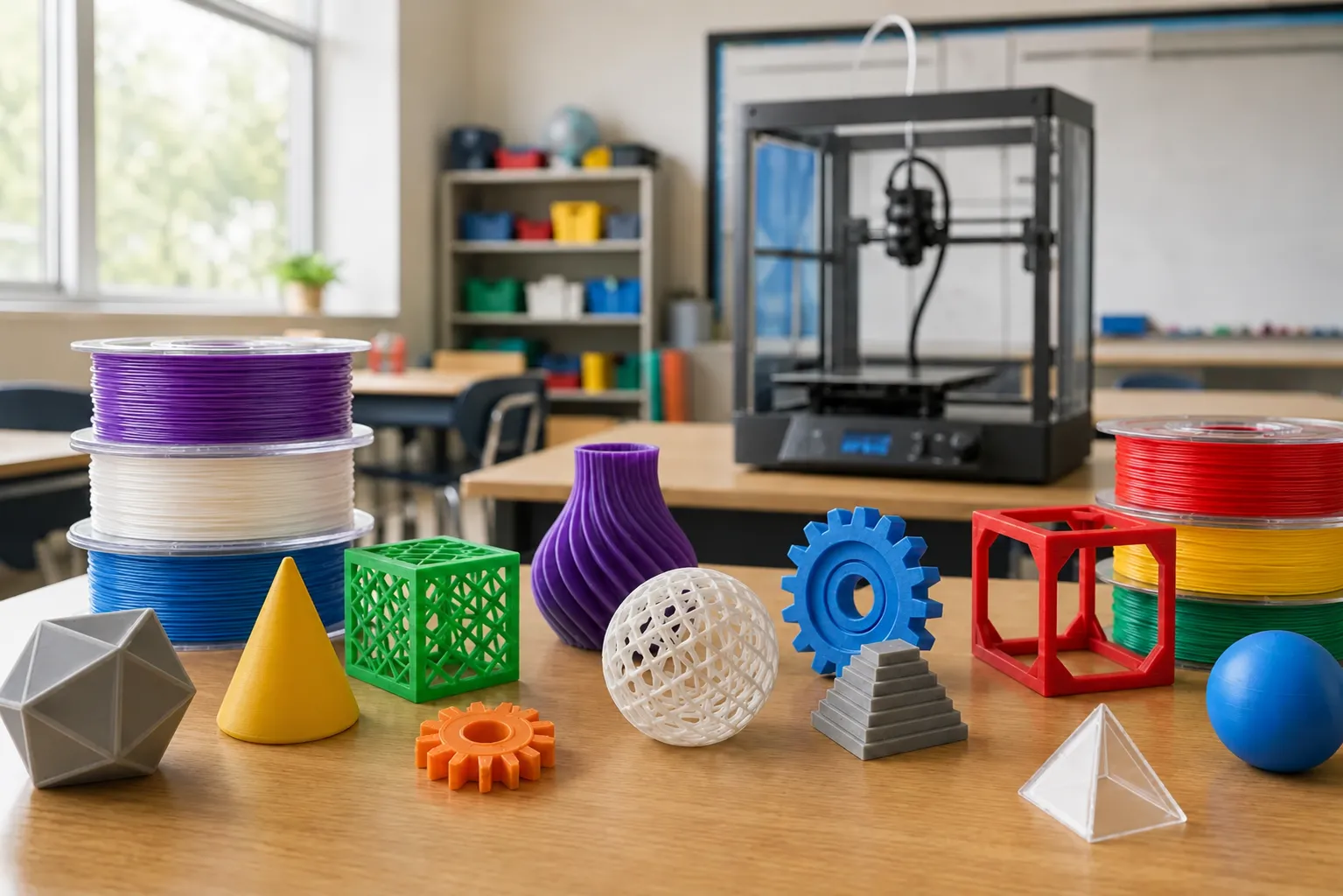
Modern education is becoming increasingly hands-on. Across schools, universities, makerspaces, and research laboratories, 3D printing solutions are helping students move beyond textbooks by transforming digital ideas into physical models. Whether building engineering prototypes, architectural models, robotic components, or creative design projects, additive manufacturing encourages innovation, critical thinking, and practical problem-solving.
However, successful classroom printing depends on more than just a good printer. Choosing reliable, easy-to-print materials is equally important. Educational institutions need filaments that are consistent, beginner-friendly, affordable, and suitable for a wide variety of learning environments.
Felarus offers a complete range of 3D printing filaments for education, from everyday PLA to engineering-grade PETG, ABS, TPU, ASA, and carbon fiber composites. Our materials help educators deliver reliable printing experiences while giving students the confidence to experiment, create, and learn.
Whether you are a school purchasing manager, university laboratory, STEM training center, educational distributor, or makerspace operator, Felarus provides dependable filament solutions designed to support every stage of the learning process.
Why Educational Institutions Choose 3D Printing
The adoption of 3D printing in education continues to grow because it combines creativity with practical learning. Instead of simply reading about engineering, mathematics, biology, or product design, students can manufacture real objects, analyze their performance, and improve them through rapid iteration.
Hands-on Learning
Physical models make complex concepts easier to understand. Students can explore geometry, mechanics, electronics, anatomy, and industrial design through interactive projects rather than passive learning.
Encourage Creativity
3D printing allows students to experiment without expensive tooling. Ideas can quickly become prototypes, encouraging innovation and design thinking throughout the learning process.
Faster Project Development
Students can move from CAD design to finished parts within hours, allowing more time for testing, discussion, and improvement during a semester.
Cost-Effective Teaching
Compared with CNC machining or traditional manufacturing, desktop 3D printing dramatically reduces production costs while minimizing material waste.
Classroom-Friendly Materials
Easy-print materials like PLA filament provide excellent printability with relatively low odor, making them suitable for many classroom environments when printers are used according to manufacturer guidelines and with appropriate ventilation.
Multi-Disciplinary Applications
From engineering and robotics to architecture, medicine, industrial design, and art, one printer can support multiple departments across an educational institution.
Typical Education 3D Printing Workflow
Educational projects usually follow a simple workflow that encourages students to learn by doing.
| Stage | Objective | Recommended Material |
|---|---|---|
| Concept Development | Brainstorm and sketch ideas | PLA |
| 3D CAD Design | Create digital models | PLA |
| Prototype Printing | Produce the first physical model | PLA / PETG |
| Testing & Evaluation | Verify dimensions and functionality | PETG / ABS |
| Design Improvement | Optimize structure and performance | PETG / ASA |
| Final Presentation | Display completed projects | PLA / Matte PLA |
By repeating this cycle, students learn not only how to design products but also how to identify problems, evaluate performance, and continuously improve their solutions.
Common Educational Applications
STEM Education
STEM programs introduce students to science, technology, engineering, and mathematics through practical learning. 3D printing allows teachers to create interactive lessons where students design bridges, gears, mathematical models, or scientific equipment.
PLA is typically the preferred material because it is easy to print, affordable, and available in a wide range of colors. Students can complete projects with minimal printer adjustments, making classroom management much easier.
Recommended Materials: PLA, Matte PLA
- Beginner-friendly printing
- Excellent dimensional accuracy
- Affordable for classroom use
- Wide color selection
- Minimal post-processing
Engineering Education
Engineering students require materials capable of functional testing rather than simple visual models. Components such as brackets, fixtures, housings, and mechanical assemblies often need greater strength and durability.
PETG offers an excellent balance between printability and mechanical performance, while ABS provides higher temperature resistance for more demanding engineering applications.
Recommended Materials: PETG, ABS
- Functional mechanical testing
- Higher impact resistance
- Better structural strength
- Improved durability
- Suitable for laboratory projects
Architecture & Construction Models
Architectural students rely on accurate scale models to communicate design concepts. Surface quality, dimensional precision, and color consistency are often more important than mechanical strength.
PLA and Matte PLA produce smooth surfaces with sharp details, making them excellent choices for architectural presentations.
Recommended Materials: PLA, Matte PLA
- High printing accuracy
- Smooth surface finish
- Excellent detail reproduction
- Easy painting and finishing
- Professional presentation quality
Robotics & Electronics Projects
Many robotics competitions require students to design lightweight frames, protective covers, gears, wheels, and flexible components.
PETG provides durability for structural parts, while TPU is ideal for tires, cable protection, vibration dampers, and flexible connectors.
Recommended Materials: PETG, TPU
- Impact resistance
- Flexible components
- Durable moving parts
- Lightweight structures
- Reliable mechanical performance
Product Design Courses
Industrial design and product development courses focus heavily on rapid iteration. Students frequently print multiple versions of the same design before reaching the final concept.
Fast printing materials reduce project time while allowing students to validate ergonomics, aesthetics, and functionality.
Recommended Materials: PLA, PETG
- Fast prototype development
- Easy design modifications
- Low production cost
- Excellent appearance
- Functional evaluation
Student Competitions
Competitions encourage students to combine creativity with engineering knowledge. Lightweight and durable materials often provide competitive advantages.
Carbon Fiber PLA or Carbon Fiber PETG can improve stiffness while maintaining relatively low weight for selected components.
Recommended Materials: Carbon Fiber PLA, Carbon Fiber PETG, PETG
- Higher rigidity
- Lightweight structures
- Professional appearance
- Improved performance
- Engineering-grade quality
Recommended Materials for Education
| Material | Best For | Key Advantages |
|---|---|---|
| PLA | Primary schools, STEM, beginner education | Easy printing, low warping, affordable |
| Matte PLA | Architecture, presentation models | Premium surface finish |
| PETG | Engineering education | Tough, durable, chemical resistant |
| ABS | Mechanical engineering | Heat resistant, functional parts |
| TPU | Robotics, wearable projects | Flexible and impact resistant |
| ASA | Outdoor education projects | UV and weather resistance |
| Carbon Fiber PLA | University engineering | Lightweight and rigid |
Why Choose Felarus for Educational Projects
Educational institutions require more than affordable filament. They need consistent quality that minimizes printing failures and supports hundreds of student projects throughout the academic year.
Felarus maintains strict manufacturing standards to ensure every spool delivers reliable performance.
Consistent Diameter Control
Stable filament diameter contributes to smooth extrusion and consistent print quality, helping reduce failed prints in classroom environments.
Easy-to-Print Formulations
Our materials are designed for compatibility with most FDM printers, making them suitable for beginners and experienced users alike.
Wide Material Portfolio
From basic PLA to advanced engineering filaments, Felarus provides solutions for every level of education.
Rich Color Selection
Multiple color options support design visualization, educational demonstrations, and creative classroom activities.
OEM & Private Label Support
Educational distributors and regional brands can benefit from customized packaging, labeling, and branding services.
Stable Manufacturing Capacity
Reliable production and consistent quality help schools, universities, and distributors maintain dependable supply throughout the academic year.
FELARUS FAQ
Frequently Asked Questions
Practical answers for schools, universities, STEM programs and education distributors choosing reliable 3D printing materials.
What is the best filament for classroom use?
PLA is generally the preferred choice because it combines easy printing, consistent quality, and affordability, making it suitable for beginners and educational environments.
Which materials are suitable for engineering students?
PETG and ABS are excellent options for functional prototypes and mechanical testing. Carbon Fiber PLA can also be used for lightweight structural projects.
Can educational institutions purchase in bulk?
Yes. Felarus supports bulk purchasing for schools, universities, laboratories, distributors, and educational suppliers worldwide.
Do you offer OEM or private label services?
Yes. We provide customized packaging, private labeling, spool customization, and branding solutions for distributors and educational partners.
Which printers are compatible with Felarus filaments?
Our filaments are compatible with most FDM 3D printers that support standard 1.75 mm or 2.85 mm filament sizes, depending on the product specification.
Empower Better Learning Through 3D Printing
From primary school STEM classes to advanced university engineering laboratories, 3D printing continues to transform the way students learn, create, and innovate.
Choosing reliable materials ensures better print quality, fewer failures, and a more enjoyable learning experience for both educators and students.
Whether you are equipping an entire school district, supplying a university laboratory, or building the next generation of makerspaces, Felarus provides dependable 3D printing materials designed to support education at every level.