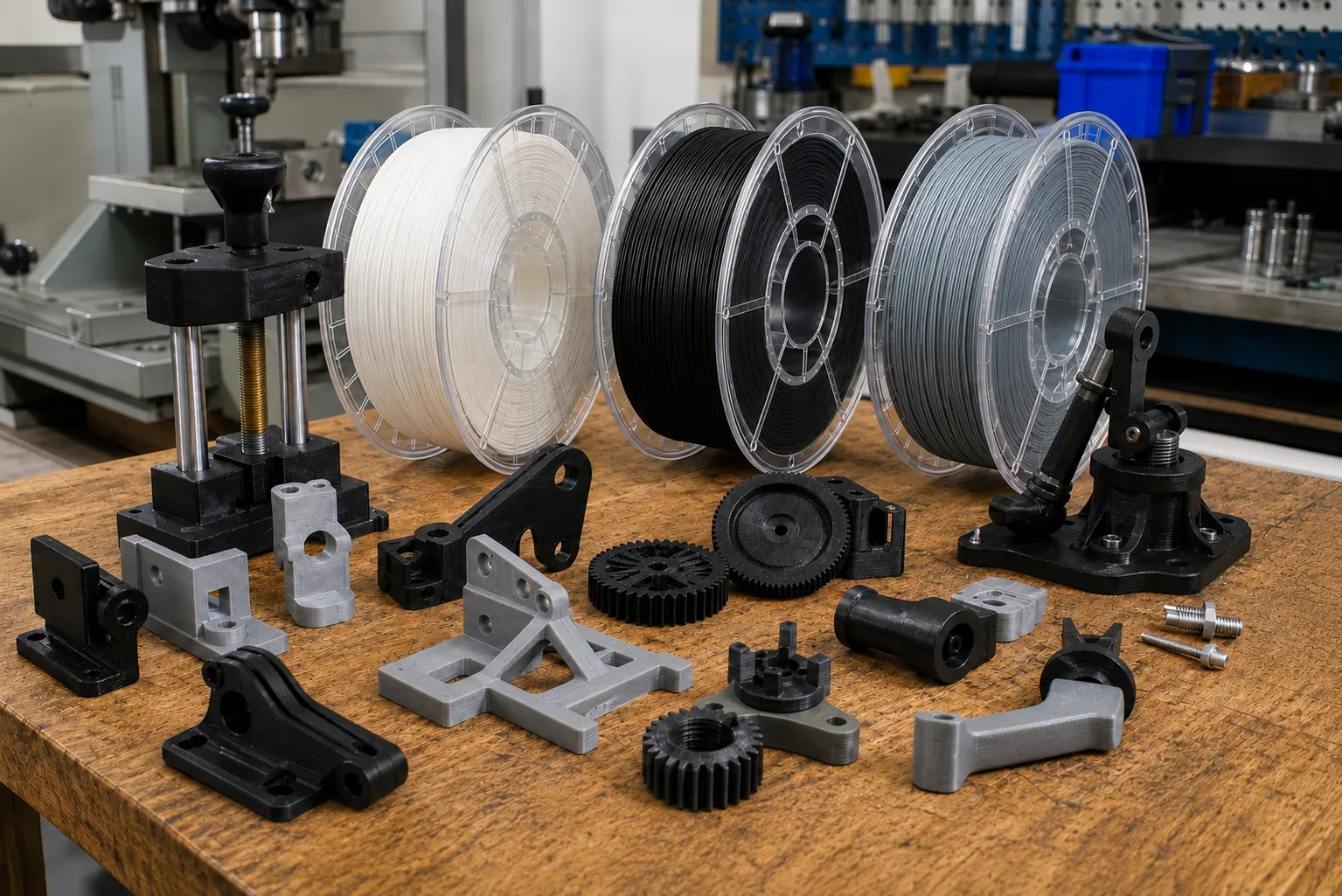
Manufacturing is becoming more agile, flexible, and cost-efficient than ever before. Traditional machining and injection molding remain essential for mass production, but more factories are now integrating industrial 3D printing into their workflows to accelerate product development, reduce tooling costs, and improve operational efficiency.
Whether you are producing functional prototypes, assembly fixtures, inspection gauges, production tooling, replacement parts, or low-volume end-use components, selecting the right engineering material is critical for consistent performance.
At Felarus, we provide reliable 3D printing filament materials designed for manufacturing environments. Our engineering filaments help factories shorten lead times, simplify production processes, and support flexible production with dependable print quality.
Why Manufacturing Uses 3D Printing
Manufacturers worldwide are adopting additive manufacturing because it enables faster innovation while reducing production complexity. Instead of waiting weeks for machined parts or expensive molds, engineering teams can produce functional tools and components within hours.
| Benefit | Manufacturing Impact |
|---|---|
| Faster development | Accelerate product design cycles by producing prototypes and testing concepts within a single day. |
| Lower tooling cost | Reduce the need for expensive molds, CNC fixtures, and outsourced tooling for low-volume production. |
| Flexible manufacturing | Modify designs quickly without changing production lines or investing in new tooling. |
| On-demand production | Print replacement parts, custom tools, and manufacturing aids exactly when they are needed. |
| Higher efficiency | Improve assembly accuracy, reduce downtime, and optimize factory workflows with customized production tools. |
| Less material waste | Produce only the required quantity of parts and reduce waste compared with many subtractive processes. |
Manufacturing Workflow
Modern manufacturers use 3D printing throughout the entire production process, not only for prototyping, but also for tooling, maintenance, and production support.
| Workflow Stage | Recommended Material | Typical Use |
|---|---|---|
| Design prototype | PLA and PLA+ | Concept models, appearance checks, and early form validation. |
| Functional prototype | PETG | Fit testing, durable prototypes, and parts that need toughness. |
| Testing | ABS | Engineering samples that require impact strength and heat resistance. |
| Assembly fixture | PETG / PA6-CF | Positioning tools, assembly aids, and repeatable production fixtures. |
| Production tooling | PA6-CF | Rigid jigs, drill guides, robotic end effectors, and tooling supports. |
| Outdoor manufacturing | ASA | Parts exposed to sunlight, weather, and outdoor operating environments. |
| Flexible components | TPU | Protective pads, flexible covers, shock-absorbing parts, and grips. |
From concept validation to factory maintenance, engineering filaments help reduce development time and improve manufacturing efficiency across the full workflow.
Common Manufacturing Applications
Assembly Fixtures
Assembly fixtures are widely used to position components accurately during production. Compared with traditional machined fixtures, 3D printed fixtures can be produced much faster while reducing manufacturing cost. Lightweight customized fixtures also improve operator comfort and increase assembly efficiency.
Recommended materials: PETG and PA6-CF carbon fiber filament.
- Faster production of custom fixtures
- Lightweight designs for easier handling
- Easy updates when assembly requirements change
- Lower tooling cost for low-volume lines
Inspection Gauges
Quality control often requires precise inspection tools for dimensional verification and assembly checking. Customized gauges printed with engineering materials can be produced quickly and updated whenever product designs change.
Recommended materials: PLA+ and PETG.
- Rapid iteration for new product versions
- Lower inspection tooling cost
- Good dimensional accuracy for checking operations
- Faster quality-control preparation
Functional Prototypes
Functional prototypes allow engineers to verify mechanical performance before mass production. Strong engineering materials enable testing of fit, strength, thermal resistance, assembly behavior, and real operating conditions.
Recommended materials: ABS, PETG, and PA6-CF.
- Faster product validation
- Reduced design risk before mold investment
- Lower development cost
- Better product quality through earlier testing
Production Tooling
Manufacturing tools such as drill guides, positioning jigs, welding fixtures, and robotic end effectors can all be produced using industrial filaments. 3D printed tooling shortens lead times while maintaining sufficient strength for daily factory use.
Recommended materials: PA6-CF and PETG.
- Short lead times for urgent tooling needs
- High rigidity for stable positioning
- Cost-effective replacement and iteration
- Easy reprinting when tools are damaged or redesigned
Replacement Parts
Production downtime can be extremely expensive. Instead of waiting for spare parts from suppliers, manufacturers can produce replacement components on demand to restore production quickly and reduce inventory pressure.
Recommended materials: ABS, PETG, and TPU.
- Reduced downtime during maintenance
- Faster repair for low-risk non-critical components
- Lower inventory cost
- On-demand production for discontinued or customized parts
End-use Parts
For low-volume production and customized products, engineering filaments enable direct manufacturing of final functional components without tooling investment. This is especially useful for small-batch production, specialized equipment, and customized assemblies.
Recommended materials: PA6-CF and ASA.
- Lightweight part design
- Excellent mechanical strength with reinforced materials
- Flexible design changes without new tooling
- Small-batch production with lower upfront cost
Application and Material Matrix
Each material has a different balance of printability, strength, heat resistance, flexibility, and outdoor durability. The table below can help manufacturing teams narrow down the best starting point.
| Application | PLA / PLA+ | PETG | ABS | ASA | TPU | PA6-CF |
|---|---|---|---|---|---|---|
| Visual prototype | ✓ | Optional | - | - | - | - |
| Functional prototype | - | ✓ | ✓ | - | - | ✓ |
| Inspection gauge | ✓ | ✓ | - | - | - | - |
| Assembly fixture | - | ✓ | - | - | - | ✓ |
| Production tooling | - | Optional | - | - | - | ✓ |
| Replacement parts | - | ✓ | ✓ | - | ✓ | ✓ |
| End-use parts | - | - | ✓ | ✓ | - | ✓ |
Recommended Materials
PLA and PLA+
PLA+ is ideal for visual prototypes, concept models, inspection gauges, and early design validation. It prints easily, provides good dimensional accuracy, and is suitable for fast iteration when mechanical load is limited.
PETG
PETG filament offers a strong balance of toughness, chemical resistance, and printability. It is a practical choice for assembly fixtures, functional prototypes, protective covers, and general manufacturing support parts.
ABS
ABS is commonly used for functional engineering prototypes where heat resistance, impact strength, and post-processing flexibility are important. It is suitable for housings, test parts, and mechanically demanding prototypes when the printing environment is controlled.
ASA
ASA is preferred for outdoor manufacturing components because it provides excellent UV resistance, weather resistance, and long-term durability. It is useful for exterior parts, outdoor fixtures, and applications exposed to sunlight.
TPU
TPU flexible filament is used for flexible parts, protective pads, bumpers, shock-absorbing components, cable protection, and wear-resistant covers. It helps manufacturers add flexibility and impact absorption to printed components.
PA6-CF and Carbon Fiber Reinforced Filament
Carbon fiber filament, including PA6-CF type materials, is suitable for industrial tooling and structural components that require high rigidity, excellent strength, dimensional stability, and lightweight performance.
Material Performance Matrix
| Property | PLA / PLA+ | PETG | ABS | ASA | TPU | PA6-CF |
|---|---|---|---|---|---|---|
| Printability | ||||||
| Strength | ||||||
| Heat resistance | ||||||
| Chemical resistance | ||||||
| Outdoor use |
Why Choose Felarus
Manufacturers require more than high-quality filament. They need a dependable partner that can provide consistent materials, flexible OEM services, stable delivery, and technical support throughout the production process.
| Felarus | Typical Limitation |
|---|---|
| Engineering-grade material options for manufacturing applications | Standard materials only |
| OEM and private label filament services for B2B partners | Limited customization |
| Stable filament diameter and consistent batch quality | Inconsistent print performance |
| Fast production planning and reliable delivery support | Longer or less predictable lead times |
| Technical material recommendations for real applications | Basic product-only service |
FELARUS FAQ
Frequently Asked Questions
Practical answers for manufacturers, distributors and engineering teams choosing reliable 3D printing materials for production workflows.
What material is best for manufacturing fixtures?
PETG and PA6-CF carbon fiber filament are excellent choices because they provide strength, dimensional stability, and durability for repeated use.
Can 3D printing replace CNC machining?
For customized tooling, prototypes, fixtures, and low-volume production, 3D printing is often faster and more economical. CNC machining remains preferable for tight tolerances, high-volume metal parts, and applications that require specific machined materials.
Which material offers the highest strength?
PA6-CF and carbon fiber reinforced filament provide the highest rigidity and mechanical strength among the manufacturing materials listed here.
Do you provide OEM and private label services?
Yes. Felarus supports OEM packaging, private branding, customized labels, bulk manufacturing solutions, and long-term supply programs for distributors and filament brands.
How do I choose the right material?
Our engineering team can recommend the most suitable material based on your application, operating environment, mechanical requirements, production goals, and printer conditions.
Ready to Improve Your Manufacturing Process?
Whether you need reliable materials for functional prototypes, production tooling, factory fixtures, replacement parts, or end-use components, Felarus provides engineering-grade filaments designed for industrial manufacturing.
Explore our PLA+, PETG, TPU, and carbon fiber filament options, or contact Felarus for a material recommendation based on your manufacturing application.