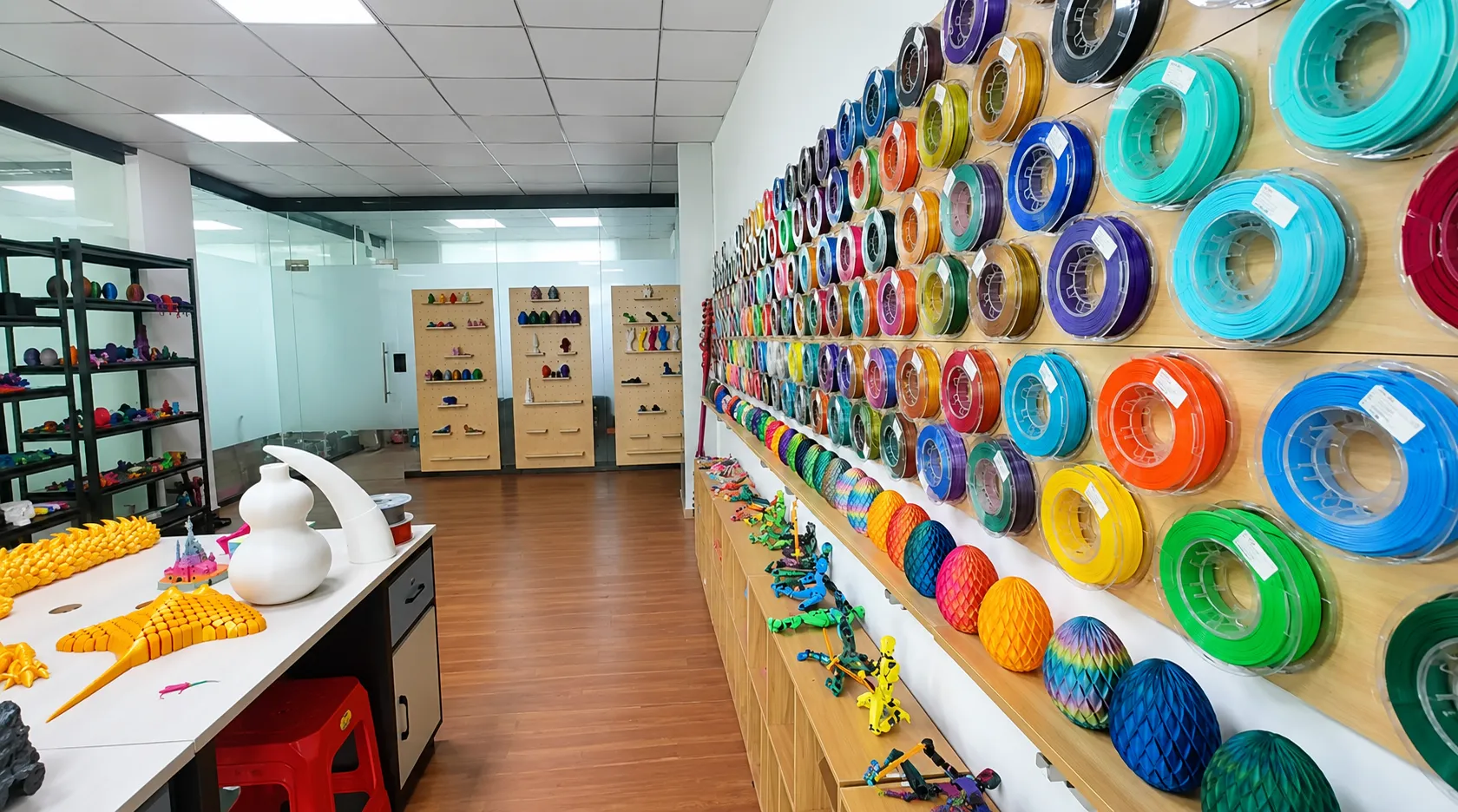
When customers visit a filament factory, the first thing they often notice is the showroom.
Rows of colorful filament spools, shelves filled with printed models, and hundreds of material samples create a strong first impression. However, what truly determines filament quality is not what customers see in the showroom—it is what happens behind the factory walls.
For distributors, private-label brands, wholesalers, and professional 3D printing businesses, understanding how filament is manufactured helps evaluate whether a supplier can consistently deliver reliable products.
Let's take a closer look at how premium 3D printer filament is produced inside a modern filament factory.
Step 1: Raw Material Selection
Every quality filament starts with quality raw materials.
Manufacturers carefully select virgin-grade polymer pellets from trusted suppliers to ensure consistent performance. Depending on the product line, materials may include: PLA, PLA-Pro, PETG, TPU, ABS, ASA, and Nylon materials.
The quality of the raw resin directly affects:
(1)Printing consistency
(2)Layer adhesion
(3)Surface finish
(4)Mechanical strength
(5)Color stability
Factories that prioritize premium materials can significantly reduce customer complaints and improve printing reliability.
Step 2: Material Drying
Moisture is one of the biggest enemies of filament quality.
Many polymers naturally absorb water from the air. Even small amounts of moisture can cause:
(1)Stringing
(2)Bubbles
(3)Rough surfaces
(4)Poor layer bonding
(5)Reduced strength
Before extrusion, raw materials are placed in industrial drying systems where temperature and drying time are carefully controlled.
Proper drying ensures the material enters the production line in optimal condition.
Step 3: Precision Extrusion
Extrusion is the heart of filament manufacturing.
The dried material enters the extrusion system where it is heated and melted under carefully controlled conditions.
Modern extrusion lines continuously monitor:
(1)Temperature
(2)Pressure
(3)Melt flow stability
(4)Production speed
The molten polymer is then pushed through a precision die to create filament with the desired diameter.
For most products, the target dimensions are:
(1)1.75mm
(2)2.85mm
Maintaining dimensional accuracy during this stage is critical for successful printing.
Step 4: Cooling and Diameter Control
After extrusion, the filament enters a controlled cooling process.
This stage may appear simple, but it has a major impact on final product quality.
If cooling occurs too quickly or unevenly, the filament may develop:
(1)Ovality
(2)Diameter fluctuations
(3)Internal stress
(4)Surface defects
Advanced production lines use laser measurement systems to monitor filament diameter in real time.
Automatic adjustments help maintain tight tolerances throughout the production process.
Consistent diameter means smoother feeding and fewer printing failures for end users.
Step 5: Spooling and Winding
Even perfectly manufactured filament can create problems if it is wound incorrectly.
Modern winding systems automatically guide the filament onto spools using precise tension control.
Proper winding prevents:
(1)Tangling
(2)Cross-over loops
(3)Feeding interruptions
(4)Print failures
A well-organized spool not only improves user experience but also reduces support issues for distributors and retailers.
Step 6: Quality Inspection
Professional manufacturers perform multiple quality checks throughout production.
Common inspection procedures include:
Diameter Testing
Verifying filament dimensions remain within specification.
Weight Verification
Ensuring spool weight matches product requirements.
Surface Inspection
Checking for contamination, bubbles, or visual defects.
Print Testing
Producing actual printed parts to evaluate:
(1)Layer adhesion
(2)Printability
(3)Surface quality
(4)Color consistency
Regular quality inspections help ensure every batch performs consistently in real-world printing environments.
Step 7: Packaging and Shipping
After passing quality control, filament moves to the packaging stage.
Packaging is designed to protect the product from moisture and transportation damage.
Typical packaging includes:
(1)Vacuum sealing
(2)Desiccant packs
(3)Protective boxes
(4)Batch identification labels
Proper packaging helps maintain filament quality during international shipping and long-term storage.
For distributors and retailers, this means fewer damaged products and a better customer experience.
Step 8: OEM and Private Label Services
Many filament factories do more than manufacture products.
They also provide OEM and private-label solutions for brands worldwide.
These services often include:
(1)Custom spool designs
(2)Private-label packaging
(3)Custom colors
(4)Material development
(5)Brand-exclusive product lines
For businesses looking to build their own filament brand, working with an experienced OEM manufacturer can significantly reduce development time and investment costs.
Why Manufacturing Quality Matters
A showroom can demonstrate a manufacturer's product range and capabilities, but true quality comes from the production process behind the scenes.
Every stage—from raw material selection to final packaging—affects how filament performs on a customer's printer.
For distributors, wholesalers, and private-label brands, choosing a manufacturing partner is about more than price. It is about consistency, reliability, and long-term business growth.
When evaluating a filament supplier, always look beyond the showroom and understand how the products are actually made. A professional manufacturing process is often the difference between occasional success and consistent customer satisfaction.