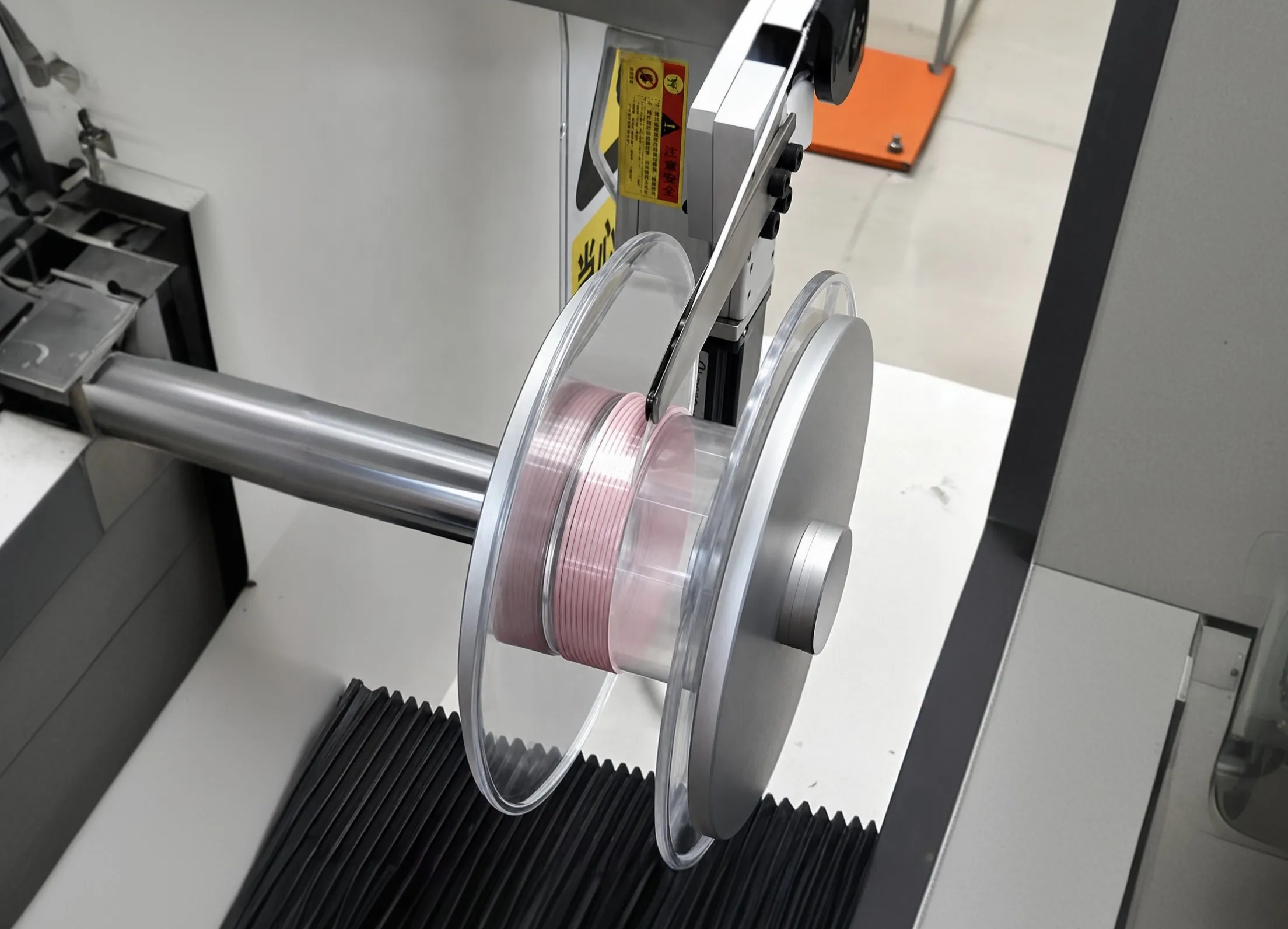
For OEM brands, distributors, wholesalers, print farms, and industrial buyers, batch-to-batch consistency is often more important than the lowest unit price. A filament can look competitive on a quotation sheet, yet still become expensive if the second or third production batch prints differently from the first one.
Consider a common purchasing story. A distributor approves a 2,000 kg trial order after smooth sample prints, then reorders the same SKU two months later. Customers now report nozzle clogging, stringing, diameter variation, color shift, and returns. The problem is not simply PLA, PETG, or TPU. It is weak batch-to-batch consistency filament control. Professional buyers compare manufacturing repeatability, not only quotations.
This guide explains how to evaluate consistency when buying 3D printer filament in bulk from an OEM filament manufacturer in China, with a focus on supplier documents, batch comparison, and factory controls.
Manufacturing Consistency Workflow
The Complete Filament Manufacturing Consistency Workflow
Consistency is built into the process, not inspected only at the end.
Why Batch-to-Batch Consistency Is the Hidden Cost Driver When Buying Filament in Bulk
When buyers compare a wholesale filament supplier, the first discussion is usually price per kilogram. That is understandable, but incomplete. A lower price can disappear quickly if every new shipment requires new slicer profiles, extra drying, longer incoming inspection, or replacement stock.
Batch instability is especially painful for recurring buyers. An OEM brand needs the same shelf color and packaging experience across repeat orders. A distributor needs predictable returns. A print farm needs stable throughput across dozens or hundreds of machines. An industrial customer needs the material to meet the same functional requirement every time.
From Felarus factory experience with overseas buyers, the most expensive problems rarely come from one failed spool. They come from uncertainty. If the next pallet feels uncertain, teams increase safety stock, slow reorder planning, and requalify material. That is why OEM filament consistency should be treated as a purchasing metric.
What Batch-to-Batch Consistency Means When Sourcing from an OEM Filament Supplier
For procurement teams, batch consistency means that three separate production runs of the same SKU can be used with the same customer expectation. It does not mean every measurement is mathematically identical. It means resin behavior, drying condition, extrusion stability, diameter tolerance, color, winding, packaging, and traceability are controlled within a defined range.
A serious OEM filament supplier should explain how the factory controls the eight areas below. Together, they form the repeatability system behind stable bulk filament purchasing.
OEM Filament Consistency Map
Eight Factory Control Points Buyers Should Verify
Use these checkpoints to understand whether consistency is managed across the full production process.
Resin Consistency
Stable incoming resin and qualified material suppliers reduce variation before extrusion begins.
Drying Consistency
Controlled drying protects moisture-sensitive materials and supports smoother surface quality.
Extrusion Stability
Temperature, screw speed, and line speed must remain controlled during each production run.
Diameter Tolerance
Online monitoring is more reliable than occasional manual checks after production is complete.
Color Consistency
Repeat retail SKUs and private label colors need retained standards and controlled matching.
MFI Consistency
Stable melt flow helps repeat print temperature, extrusion behavior, and surface results.
Mechanical Strength
Functional buyers should confirm tensile or application-based performance across batches.
Packaging Consistency
Vacuum bags, desiccant, carton labels, and batch codes protect the material after production.
A good sample proves that one batch worked. A good quality system proves that the factory can repeat it.
Why Batch Inconsistency Raises Costs for Filament Distributors, Print Farms and Industrial Production
Batch inconsistency creates operational cost in quiet ways. A 100-machine print farm may not lose money because one spool failed. It loses money because every new batch forces retuning, test prints, operator checks, and delayed production.
For distributors, inconsistency shows up as customer support. Buyers may complain that the same color no longer matches the previous spool, or that a material that printed cleanly before now strings at the same temperature. For OEM brands, inconsistent packaging and labels can damage retail confidence. For industrial production, unstable mechanical performance can delay fixtures, tooling, and prototype validation.
Hidden Cost Comparison
Stable Batch vs Unstable Batch in Bulk Filament Purchasing
The purchasing cost is not only the invoice. It is the cost of making the material usable at scale.
| Procurement Result | Stable Batch | Unstable Batch |
|---|---|---|
| Print farm operation | No repeated retuning, higher productivity, fewer failed prints. | Retuning, test prints, operator intervention, downtime. |
| Distributor support | Lower return rate and more predictable customer feedback. | Complaints, warranty cost, and brand reputation pressure. |
| OEM brand control | Repeatable color, packaging, and SKU performance. | Color drift, inconsistent labels, and uncertain reorder quality. |
7 Critical Quality Indicators Every OEM and Wholesale Filament Buyer Should Verify
The highest-value part of a filament supplier audit is knowing which indicators to request before approval. Seven indicators connect factory control with purchasing risk.
1. Filament Diameter Tolerance for Bulk Filament Purchasing
Diameter tolerance affects extrusion flow, surface quality, and dimensional accuracy. Buyers should ask whether the factory uses laser monitoring and whether a diameter report can be provided for the batch. For most B2B orders, the key question is not only the tolerance number, but whether the factory can show how it is measured during production.
2. Filament Moisture Control for Print Farm Applications
Moisture can cause popping, rough surface texture, stringing, weak layer bonding, and inconsistent extrusion. Filament moisture control matters for PLA, PETG, TPU, nylon blends, and carbon fiber materials. A professional supplier should control drying time, drying temperature, packaging speed, vacuum sealing, and desiccant placement.
3. MFI Consistency Filament Testing for OEM Orders
Melt Flow Index, or MFI, helps indicate whether the material melts and flows consistently. For OEM and private label programs, MFI consistency filament testing helps reduce the risk that a later batch needs a different print temperature or produces a different surface result.
4. Filament Color Consistency for Private Label SKUs
Color is a brand issue, not just a visual issue. If a distributor sells repeat SKUs, the same red, black, white, gray, or custom color should remain stable over multiple batches. A factory should be able to compare color with a retained standard sample or Delta E measurement when required.
5. Mechanical Strength for Industrial Filament Applications
Industrial buyers using filament for jigs, fixtures, housings, brackets, or functional prototypes should ask for tensile or application-based strength data. This is particularly important when buying engineering materials or reinforced options such as carbon fiber filament.
6. Spool Winding Quality for Continuous Printing
Winding quality affects unattended printing. Tangled filament can stop a long print even if the material itself is good. For print farms, smooth winding and stable spool tension are part of production continuity.
7. Batch Traceability for Complaint Handling
Traceability allows the supplier and buyer to identify production date, raw material lot, extrusion line, QC record, and shipment details. Without traceability, every complaint becomes a guess.
| Quality Indicator | Why It Matters for Bulk Buyers | What Professional Suppliers Provide |
|---|---|---|
| Diameter | Print accuracy and extrusion stability. | Diameter report. |
| Moisture | Surface finish and layer bonding. | Moisture test or drying record. |
| Color | OEM branding and repeat SKU appearance. | Color sample or Delta E report. |
| MFI | Stable melt flow and repeat print settings. | MFI test record. |
| Strength | Mechanical performance for functional parts. | Tensile or application test. |
| Winding | Print continuity for farms and long jobs. | Visual QC and spool inspection. |
| Traceability | Fast complaint handling and batch review. | Batch number and production record. |
What Quality Documents Should You Request Before Buying Filament in Bulk?
Before placing a repeat order, procurement teams should request documentation that proves the supplier can manage the production process and connect delivered material to measurable controls.
For a serious bulk filament purchasing program, ask for COA, TDS, SDS, diameter report, moisture record, MFI report, color confirmation, packaging inspection, batch number, production date, and final inspection record. Buyers comparing 3D printing filament products should also confirm which documents are standard and which require special testing before production.
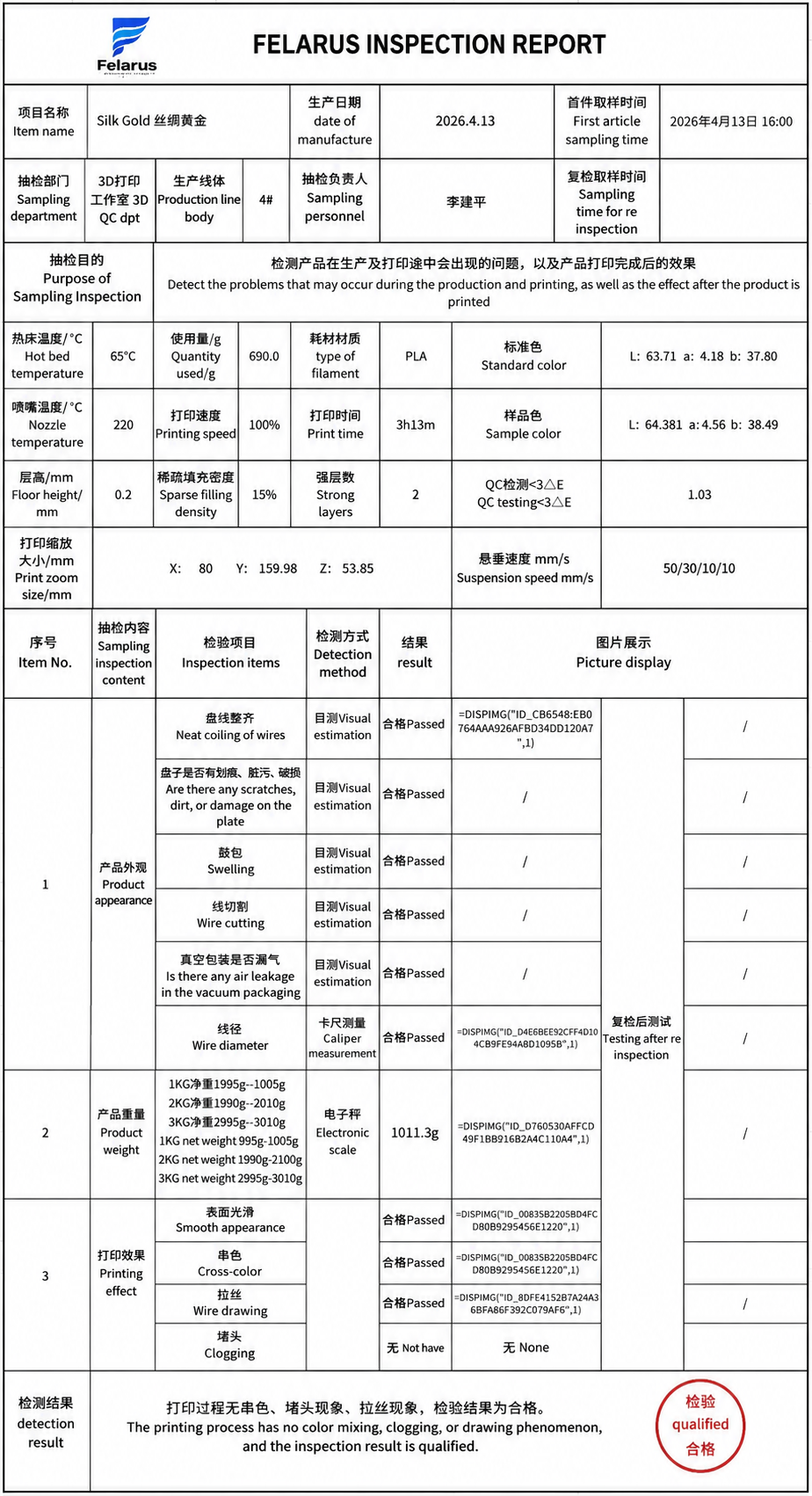
Supplier audit tip: Request the same document set for three consecutive production batches. A supplier that can show one good batch may still struggle with repeatability. A supplier that can compare three batches is much easier to qualify for long-term OEM or wholesale cooperation.
How Professional Procurement Teams Compare Three Filament Production Batches
A practical supplier qualification method is to compare Batch A, Batch B, and Batch C under the same inspection logic. This helps buyers avoid approving a supplier based on one carefully prepared sample.
| Inspection Item | Batch A | Batch B | Batch C |
|---|---|---|---|
| Diameter tolerance | Pass | Pass | Pass |
| Moisture control | Pass | Pass | Pass |
| Color consistency | Confirmed | Confirmed | Confirmed |
| Print quality | Stable | Stable | Stable |
| Tensile or application test | Recorded | Recorded | Recorded |
The same approach can be used for application-specific buying. A distributor may compare repeat colors for retail SKUs. A print farm may compare PLA+ and PETG across long jobs. A manufacturing buyer may test TPU or reinforced materials for fixtures, protective parts, and functional components.
Supplier Audit Checklist for Choosing a Wholesale Filament Manufacturer
Before choosing a long-term supplier, ask direct questions. Can the factory provide QC reports? Can you compare three consecutive batches? Does every spool or carton include a traceable batch number? How is moisture controlled before packaging? Are production records archived?
A mature supplier should welcome these questions because they support a repeatable supply chain.
Supplier Qualification Flow
From Supplier List to Mass Production
A simple process for distributor, OEM, and print farm buyer evaluation.
Supplier List
Shortlist manufacturers by material range, OEM capability, communication, and export experience.
Request QC Reports
Ask for diameter, moisture, MFI, color, packaging, and batch records before trial ordering.
Compare Batches
Review at least three production records to understand repeatability, not only sample quality.
Test Samples
Print samples under your real print farm, distributor, or industrial application conditions.
Factory Audit
Check production workflow, traceability, inspection tools, storage, and packaging control.
Trial Order
Use a controlled pilot order to confirm color, winding, documentation, and after-sales response.
Mass Production
Scale only after quality data, application tests, and communication process are proven.
| Supplier Capability | Price-Only Supplier | Documented OEM Supplier |
|---|---|---|
| Batch traceability | ||
| QC documentation | ||
| Repeat-order stability | ||
| Engineering support |
How Felarus Maintains Batch-to-Batch Consistency Across OEM and Private Label Orders
At Felarus, batch consistency is managed as a factory system. In our China filament production workflow, the process starts with premium virgin raw materials and incoming material control. Drying is managed before extrusion, and laser diameter monitoring helps keep filament within the required tolerance range.
For repeat OEM and private label orders, we control color standards, packaging details, carton marks, label requirements, spool winding, vacuum sealing, and batch records. Many B2B buyers are not only purchasing material; they are protecting their own brand promise.
Felarus can support buyers with samples, QC reports, batch comparison data, and application discussion before scaling an order. A distributor may start with PLA+, PETG, and Matte PLA; a print farm may focus on everyday stability; an industrial buyer may prioritize PETG, TPU, or carbon fiber materials. The control logic is the same: define the requirement, test the material, record the batch, and keep repeat production within the agreed standard.
You can review our production environment on the Felarus factory page, compare available materials on the product page, or contact Felarus to request sample evaluation and QC documentation for your next order.
How to Choose a Reliable Filament Supplier for Long-Term OEM and Wholesale Cooperation
The best supplier is not always the cheapest supplier. A reliable supplier combines price, quality system, batch stability, documentation, communication, engineering support, traceability, delivery stability, and OEM experience. This is especially true for buyers who plan repeat orders rather than one-time spot purchases.
Use this approval checklist before moving a supplier into a long-term program.
Compare Three Batches
Review three production batches, not only one sample spool, before approving recurring supply.
Request Core Documents
Ask for COA, TDS, SDS, diameter report, moisture record, MFI record, and color confirmation.
Inspect Packaging Control
Check winding, vacuum bags, desiccant, carton labeling, and batch number format.
Run a Pilot Order
Test a controlled order before moving into private label packaging or larger wholesale volume.
Confirm Traceability
Make sure the factory can investigate complaints through batch records and production dates.
Match the Application
Choose suppliers that understand your print farm, distributor, OEM, or industrial use case.
For OEM brands, distributors, wholesalers, print farms, and industrial customers, the real purchasing question is not whether one kilogram can be 0.20 USD cheaper. The question is whether every batch can keep the same printing behavior, color expectation, packaging quality, and documentation discipline. Stable batch-to-batch consistency means less retuning, fewer returns, higher customer satisfaction, and a stronger long-term brand reputation.
Procurement FAQ
Frequently Asked Questions About Batch-to-Batch Consistency Filament Buying
Practical answers for OEM brands, distributors, print farms, and industrial buyers qualifying a 3D printer filament manufacturer.
What is batch-to-batch consistency in 3D printer filament?
It means different production batches of the same SKU deliver repeatable printing behavior, diameter control, color, moisture level, winding quality, packaging, and traceability within the supplier's defined quality range.
How many batches should I compare before approving an OEM filament supplier?
For long-term OEM or wholesale cooperation, compare at least three batches when possible. This helps confirm whether the supplier can repeat production quality rather than only prepare one good sample.
Which documents should a wholesale filament supplier provide?
Common documents include COA, TDS, SDS, diameter report, moisture record, MFI report, color confirmation, packing inspection, batch number, production date, and final QC inspection record.
Why does batch consistency matter for print farms?
Print farms depend on repeat settings and predictable throughput. If each batch prints differently, operators spend more time retuning machines, testing profiles, and recovering failed prints.
Can Felarus provide sample testing and QC reports for bulk filament buyers?
Yes. Felarus can support sample evaluation, batch comparison, QC documentation, and OEM production planning for buyers preparing repeat wholesale or private label filament orders.
Bulk Filament Supplier Qualification
Evaluate Felarus for Your Next OEM or Wholesale Filament Order
If you are comparing suppliers for a repeat bulk order, Felarus can provide samples, QC reports, batch comparison support, and application guidance.