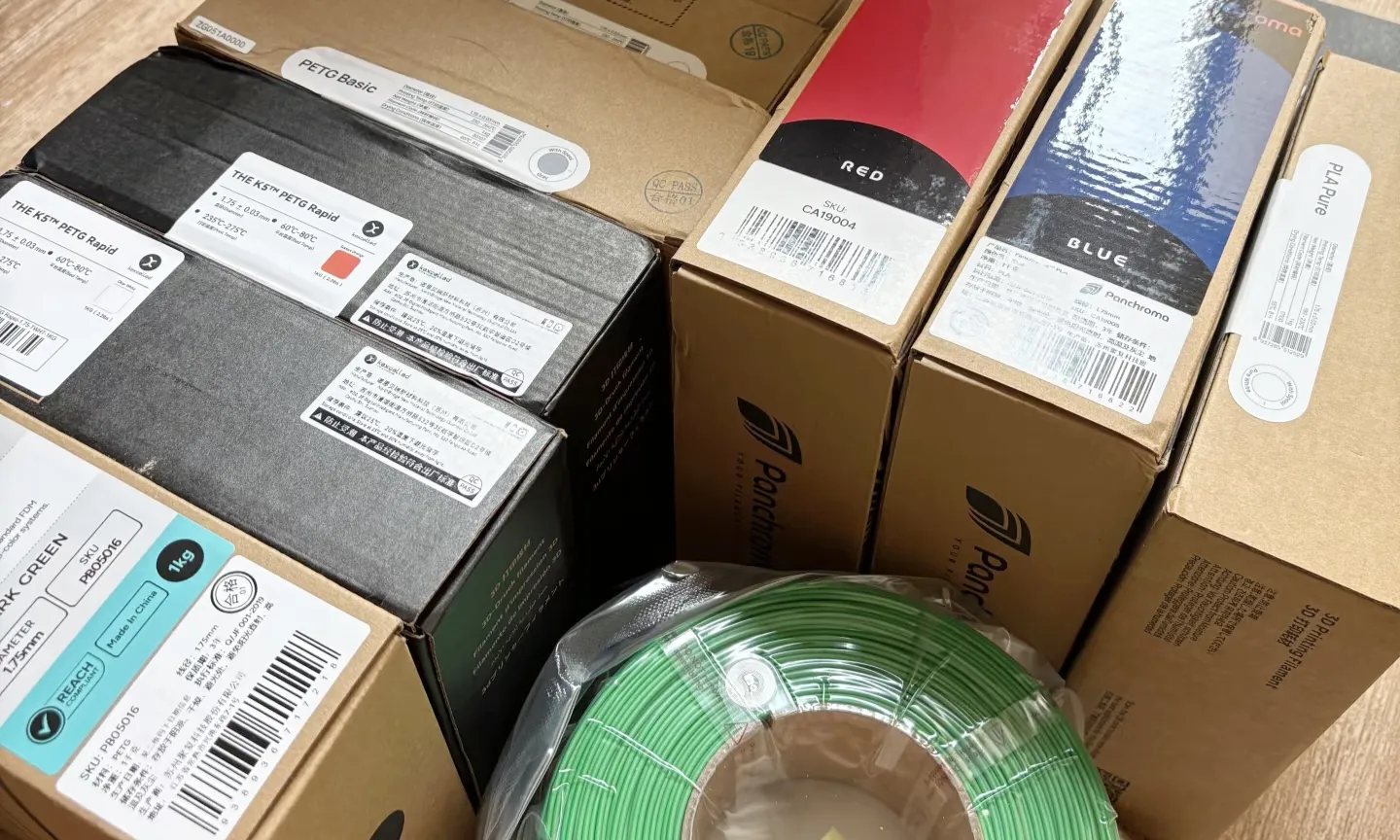
One spool of PLA may cost 14 dollars, while another sells for 20 dollars or more. Both are labeled PLA, both weigh 1 kg, and both claim tight diameter tolerance. So what exactly are you paying for: better filament, better support, or simply a better logo?
That question matters to hobby users, print farms, online sellers, distributors, and private-label filament brands. A low spool price can be attractive, but a failed print, inconsistent color, poor winding, moisture damage, or delayed reorder can quickly erase the saving. At the same time, a premium brand price does not automatically prove that the material itself is twice as good.
Brand-Name, Generic, OEM and Private-Label Filament: What Is the Difference?
Before comparing price, it helps to separate the business model from the material quality. Many buyers use the words brand-name, generic, OEM, and private-label as if they describe quality levels. In reality, they describe how filament is produced, packaged, sold, and supported.
What Is Brand-Name Filament?
Brand-name filament is sold under an established brand with recognizable packaging, product information, retail channels, and usually some level of customer support. It may be sold through Amazon, a local distributor, a brand website, or a professional reseller. The brand may own its own factory, or it may work with an OEM manufacturing partner.
What Is Generic Filament?
Generic filament can mean several things: low-cost material with little brand presence, platform-seller filament in standard packaging, a factory standard formula, or product purchased and re-packed by a reseller. Generic filament is not one fixed quality grade. Some generic products are weakly controlled, while others are made by experienced factories but sold without high marketing cost.
What Are OEM and Private-Label Filaments?
OEM filament is produced by a manufacturer according to a customer's material, color, packaging, and business requirements. Private-label filament is produced by a factory and sold under the buyer's own brand. This is where OEM 3D printer filament manufacturing becomes important for distributors, online sellers, and filament brands that want consistent supply without building their own extrusion lines.
| Type | Manufactured By | Sold Under | Customization | Typical Price |
|---|---|---|---|---|
| Brand-name filament | Brand-owned or OEM factory | Established brand | Low to medium | High |
| Generic filament | Various factories | Generic or seller name | Low | Low |
| OEM filament | Professional manufacturer | Customer brand | High | Factory-based |
| Private-label filament | OEM manufacturer | Distributor or retailer | Medium to high | Medium |
The real comparison is not always “brand versus no brand.” In many cases, it is well-controlled manufacturing versus poorly controlled manufacturing.
Why Does Premium Filament Cost More?
A premium spool price is built from several cost layers. Some layers create real print value. Others are part of retail distribution and brand positioning.
Raw Material and Additive Formulation
Two spools labeled PLA can still perform differently. The resin grade, melt flow behavior, pigment quality, toughening additives, flow modifiers, and special effect additives all affect printing. Matte PLA, silk PLA, high-speed PLA, and standard PLA should not be judged only by base resin cost. Buyers comparing material families can start with Felarus PLA and PLA+ filament as a reference point for everyday printing applications.
Quality-Control Costs
Real quality control costs money. A responsible factory must manage raw material drying, filtration, extrusion temperature, online diameter monitoring, roundness, net weight, batch records, packaging inspection, and sample printing. These checks help prevent the common gap between a good first sample and unstable repeat orders.
Packaging, Distribution and Inventory
Premium brands often include retail packaging, vacuum bags, desiccant, warehouse inventory, Amazon fees, distributor margin, return handling, and support cost in the final price. These services can be useful for small buyers who need quick delivery and low ordering risk.
Marketing and Brand Premium
Not every dollar of a premium spool goes into manufacturing. Some of the retail price pays for advertising, influencer cooperation, content marketing, local channel development, brand awareness, and after-sales support. This is not automatically negative. It simply means buyers should understand what they are paying for.
Price Structure
What Makes Up the Retail Price of Filament?
Illustrative cost structure only. Actual percentages vary by material, market, channel, and order volume.
Does Premium Filament Actually Print Better?
Sometimes yes, sometimes no. A good premium brand may print more predictably because it has mature profiles, stable batches, controlled packaging, and support. But a quality-controlled OEM filament can also print extremely well if the factory manages the process properly.
Diameter Consistency and Roundness
Diameter tolerance is often printed on the box, but the average number is only one signal. Buyers should also care about short-distance variation, roundness, and consistency across the entire spool. Two suppliers may both claim ±0.02 mm, yet the actual control process can be very different.
Winding Quality
Good winding supports long unattended prints, print farm production, and smooth feeding. Poor winding can increase feed resistance or cause spool-edge problems. Still, not every tangle is caused by factory winding. If the filament end is released and crosses under another loop during storage, the user can also create a knot-like failure.
Moisture Control
Moisture control is critical for PETG, TPU, nylon, PC, and carbon-fiber materials. Drying before extrusion, sealed packaging, desiccant quality, and storage conditions all influence bubbles, rough surface texture, stringing, brittleness, and extrusion stability. Buyers working with tougher functional parts often compare Felarus PETG filament because PETG makes moisture and packaging quality easy to observe during printing.
Color and Batch Consistency
Color consistency may not matter for a one-off hobby print, but it matters greatly for commercial products, multi-part sets, retail inventory, print farms, and repeat reorders. A premium brand may manage this well, but an OEM factory with stable color control and batch records can also support repeat purchasing.
Print Profiles and Ease of Use
Premium brands often provide tested temperatures, printer profiles, and troubleshooting guidance. That lowers setup time for less experienced users. Experienced users can often achieve similar results from a verified OEM filament by printing a temperature tower, calibrating flow, and confirming drying behavior.
| Quality Signal | Premium Brand | Unverified Low-Cost | Quality-Controlled OEM |
|---|---|---|---|
| Diameter consistency | |||
| Batch consistency | |||
| Print profile support | |||
| Customization | |||
| Cost efficiency |
The Hidden Cost of Cheap Filament
Cheap filament becomes expensive when buyers compare only spool price and ignore failed-print cost. A material that saves 2 dollars per spool can become the costly option if it creates reprints, downtime, customer complaints, or nozzle maintenance.
Cost Formula
Effective Printing Cost
Filament purchase cost + failed-print waste + labor + machine downtime
Failed prints waste material, machine time, operator attention, electricity, packaging, and delivery schedules. Batch inconsistency creates another hidden cost: a first order may print well, while the second order has a different color, flow behavior, or brittleness level. Print farms feel this most directly because machine downtime and repeat calibration reduce output capacity.
| Filament Option | Spool Price | Failure Risk | Labor and Downtime | Effective Cost |
|---|---|---|---|---|
| Low-cost unverified | Lower | Higher | Higher | Potentially high |
| Premium brand | Higher | Lower | Lower | Predictable |
| Quality OEM | Medium | Low | Low | Cost-efficient |
This model is an example only. Actual failure rates depend on printer setup, storage, material, part geometry, and operator experience.
Material Selection
Not Sure Which Filament Fits Your Application?
Compare Felarus material options for prototyping, production, resale, and OEM programs before choosing by price alone.
When Is Premium Filament Worth the Price?
Premium filament is often worth the price when predictability matters more than the lowest purchase cost. It is a practical choice for customer-facing parts, high-value long prints, small-volume buyers, users who need official print profiles, and teams that want fast local support.
It can also make sense for engineering materials and functional parts where the cost of failure is much higher than the cost of the spool. If a print takes 40 hours, or if the part must be delivered to a paying customer, stability can be more valuable than saving a few dollars.
When Is Generic or OEM Filament the Better Choice?
Generic or OEM filament can be the better choice when buyers need larger volume, repeat supply, custom colors, packaging flexibility, or private-label branding. The key is not to choose the cheapest unverified option. The better value is often a filament with verified manufacturing control at a reasonable price.
Print farms, distributors, Amazon sellers, and private-label brands often need supply flexibility that retail brands cannot provide. For flexible product lines, buyers may evaluate materials such as Felarus TPU flexible filament after confirming printer compatibility, shore hardness, packaging, and sample performance.
Decision Flow
Which Filament Option Is Right for You?
Use volume, customization, and failure risk to choose the right buying channel.
Need only 1 or 2 spools?
Choose a reliable retail brand when convenience and quick delivery are most important.
Need custom colors or private label?
Work with an OEM manufacturer that can control samples, labels, cartons, and repeat orders.
Is print failure highly expensive?
Choose a verified premium brand or a qualified OEM supplier with stable quality controls.
Still testing demand?
Test several cost-effective suppliers before scaling inventory or launching a branded line.
A Factory Perspective: What Actually Determines Filament Quality?
From a factory perspective, quality is created before the spool reaches the printer. It starts with resin selection, material drying, formula and color mixing, extrusion control, diameter monitoring, cooling, winding, packaging, and batch testing.
Raw material selection includes resin grade, melt flow index, purity, additive compatibility, pigment behavior, and the final printing requirement. Drying matters because insufficient moisture removal can cause bubbles, rough surfaces, brittle filament, stringing, and unstable extrusion.
Extrusion temperature, pull speed, and cooling conditions work together to affect diameter, roundness, internal stress, and winding stability. Continuous monitoring is more useful than random inspection because short-distance diameter changes can create feeding and surface problems.
As a China-based 3D printer filament manufacturer, Felarus works with overseas distributors, private-label brands, and commercial buyers. Our factory experience shows that consistent filament is not created by a logo. It is created by controlled raw materials, stable extrusion, moisture management, diameter monitoring, and repeatable batch standards. Buyers can review the Felarus filament manufacturing process to understand how factory capability supports long-term supply.
Factory Workflow
From Raw Material to Finished Filament
Each step controls a different quality risk before shipment.
Material selection
Confirm resin grade, formula direction, pigment behavior, and application requirements.
Drying and mixing
Reduce moisture risk before extrusion and prepare color or additive consistency.
Controlled extrusion
Manage temperature, pull speed, cooling, diameter, and roundness stability.
Winding and inspection
Check spool winding, appearance, net weight, packaging, and batch records.
Vacuum packaging
Protect material against humidity during storage, export, and local delivery.
Batch testing
Review sample printing and repeat-order requirements before shipment.
OEM Filament Supply
Looking for Consistent Filament for Resale or Large-Volume Printing?
Felarus supports OEM manufacturing, private labeling, custom colors, and packaging solutions for distributors and filament brands.
How to Evaluate Filament Before Buying
For individual users, start with practical checks: recommended print temperature, intact packaging, no obvious brittleness, clean winding, uniform color, stable diameter, and limited abnormal stringing after proper drying and calibration.
For B2B buyers, the checklist should be broader. Ask whether the supplier can provide samples, technical data when available, MOQ details, custom color options, private-label packaging, lead time planning, batch control, and a clear process for handling quality issues.
Commercial buyers can request filament samples or an OEM quotation from Felarus before placing a bulk order. A sample round helps confirm material behavior, color expectations, packaging requirements, and communication quality before scaling.
Final Verdict: Is Premium Filament Worth It?
Premium filament is worth the price when convenience, local availability, technical support, and predictable results are the highest priorities. However, a higher retail price does not automatically mean better raw material, stronger printed parts, or better batch control.
For experienced users, print farms, distributors, and private-label brands, a quality-controlled OEM filament can often deliver a better balance of consistency, customization, and cost. Do not choose filament by price alone. Choose it by consistency, traceability, application requirements, and total printing cost.
Test Before You Scale
Build a More Reliable Filament Supply Plan with Felarus
Request samples, technical specifications, or a factory quotation based on your target material, color, packaging, and order quantity.
FELARUS FAQ
Frequently Asked Questions
Practical answers for buyers comparing premium brands, generic filament, OEM production, and factory-direct supply.
Is premium filament always better than generic filament?
No. Premium brands often provide better profiles, support, and batch management, but a professional OEM filament can reach similar stability when the factory controls raw materials, extrusion, drying, packaging, and batch testing.
Why is some 3D printer filament so cheap?
Cheap filament may have lower channel cost, simpler packaging, direct factory pricing, lower marketing investment, formula differences, or weaker quality control. Low price alone does not prove poor material, but it requires careful testing.
Can cheap filament damage a 3D printer?
Standard PLA or PETG is unlikely to damage a printer simply because it is cheap. However, impurities, unstable diameter, moisture problems, or abrasive fillers can increase clogging, wear, and maintenance risk.
Is OEM filament the same as generic filament?
Not exactly. OEM describes a manufacturing relationship and customization model. Generic describes how a product is sold, often with a weak or general brand identity. Some OEM products are highly controlled, while some generic products are not.
Is Chinese filament good quality?
China has both low-cost factories and mature professional manufacturers. Quality should be judged by raw material control, equipment, inspection, batch traceability, packaging, and supplier transparency, not only by country of origin.
What filament is best for a print farm?
The best filament for a print farm is not always the cheapest spool. It should provide batch consistency, reliable supply, good packaging, low failure risk, and the lowest cost per successful print.
Can I create my own filament brand?
Yes. OEM manufacturers can often support formulas, colors, labels, spools, boxes, cartons, and outer packaging. MOQ depends on material type, color requirements, and the level of customization.
How can I test a filament supplier before bulk ordering?
Start with samples, print the same test models with consistent parameters, run temperature towers, test long prints, check color and diameter, inspect packaging, and compare more than one batch before scaling orders.